When an operator stretches its payment terms, a Dickinson, ND service company has four moves: ask for a partial or progress payment, slow its own spending, draw on a business line of credit for payroll during the wait, or take a working capital loan sized to the longer gap. The first step is putting a dollar figure on that gap.
Size the longer wait in unpaid invoices and paydays, then compare a credit line, a working capital loan and separate equipment financing. An invented example follows a move from 30-day to 75-day terms.
A Working Capital Loan for a Small or Midsize Dickinson, ND Oilfield Service Company Waiting on Net 75
SME stands for small and medium-sized enterprise. A working capital loan for an SME is the same product this site describes for any small business: one sum, paid back on a fixed schedule, used for payroll, parts and bills while customer payments are outstanding. More on it is on the working capital page.
Illustration only, invented figures: a Dickinson, ND service company bills one operator $96,000 a month, and the operator moves its terms from 30 days to 75. Over the 45 extra days, about $144,000 more sits in unpaid invoices (a month and a half of billing, our arithmetic on the invented figures). A biweekly payroll of $27,500 keeps running: 3 or 4 paydays fall inside the extra wait, $82,500 to $110,000.
In the same invented example, the crew needs two trailer-mounted pressure washers at $9,800 each that month. Those are equipment that can be financed on their own, so the working capital request stays sized to the wait rather than to the washers.
Working Capital Loan Formula and Equipment Repairs: Notes for Dickinson, ND Contractors
Two formulas answer two different questions. Working capital comes from two sides: current assets (cash, receivables and stock) minus current liabilities (bills and short-term debt due within a year). The payment on a working capital loan comes from the standard amortization formula, payment = P × r ÷ (1 − (1 + r)−n), where P is the amount, r the monthly rate and n the number of months.
Illustration only, invented figures: the same company shows $212,000 of current assets and $148,500 of current liabilities, so its working capital is $63,500. For an $85,000 loan over 18 months at 12.5% a year, r is 12.5% divided by 12 and n is 18, which gives a payment of $5,203.24; the 18 payments come to $93,658.32.
A repair to a pulling unit's drawworks or a truck engine shows up in the first formula at once: cash goes out and nothing new arrives on the asset side. That is why repairs are a working capital question and new machines an equipment question. The same arithmetic applies to builders waiting on draws, covered on the construction funding page.
Working Capital for a Micro-Sized Pulling Unit Crew Facing Slow-Paying Operators
MSME is short for micro, small and medium-sized enterprises. A pulling unit crew of three is a micro enterprise under any label, and the county has many companies near that size: in the 2023 County Business Patterns, 25 of the 60 Stark County, ND employer establishments at NAICS 2131, Support Activities for Mining, had fewer than five employees.
For a company that size, one operator moving from 30 days to 90 can tie up two months of billing. A business line of credit drawn as each payday arrives, and paid down as each late invoice clears, keeps the cost to the days the money is out. Equipment and payroll needs for the trade are on the oilfield service funding page, and Census counts for auto repair, retail, construction and the oil and gas sector on the Dickinson, ND page.
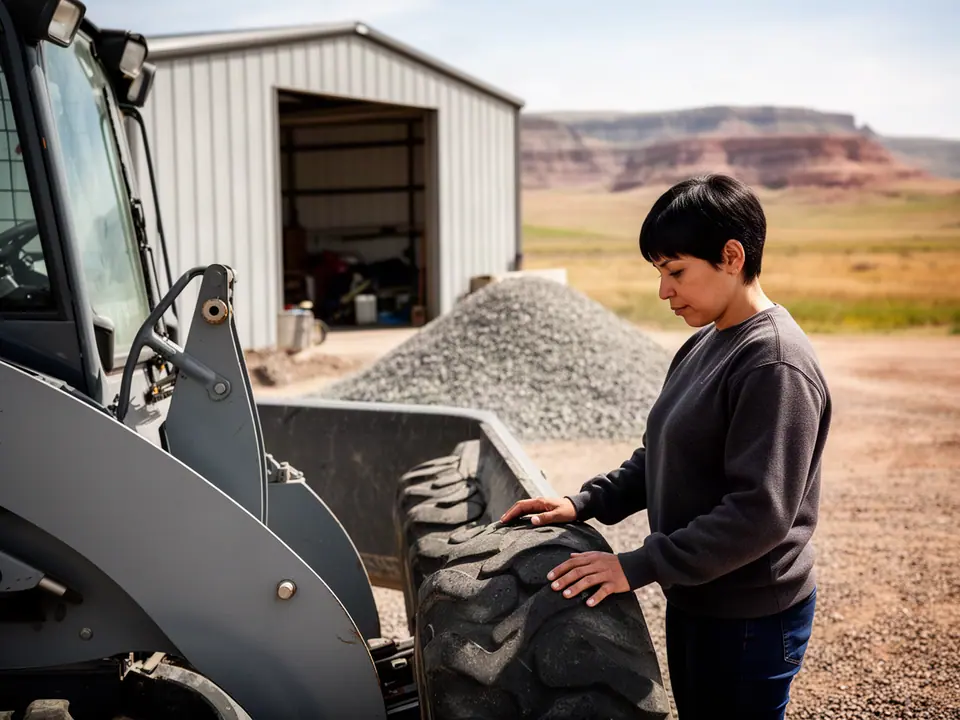
Working Capital Loan for a Woman-Owned Stark County, ND Contractor Buying a Skid Steer
A working capital loan for a woman-owned business works like any other: a partner can review the business, its statements, its revenue and its time in business. This site lists no program reserved for women-owned firms, and a woman-owned firm's request goes through the same call or form.
Illustration only, invented figures: a woman-owned contracting company in Stark County, ND buys a skid steer for $52,400 in the same month that an operator puts a $38,000 invoice for well-pad dirt work on 60-day terms. Put on a three-year term loan at 11% a year, the skid steer costs $1,715.51 a month, $61,758.36 over the 36 months. Her crew payroll of $11,200 every two weeks meets 4 or 5 paydays in the 60-day wait, $44,800 to $56,000, and that is the part a working capital loan or a credit line would carry.
By Timberwater Funding Group · Updated